Yazhe, Liu N10018263
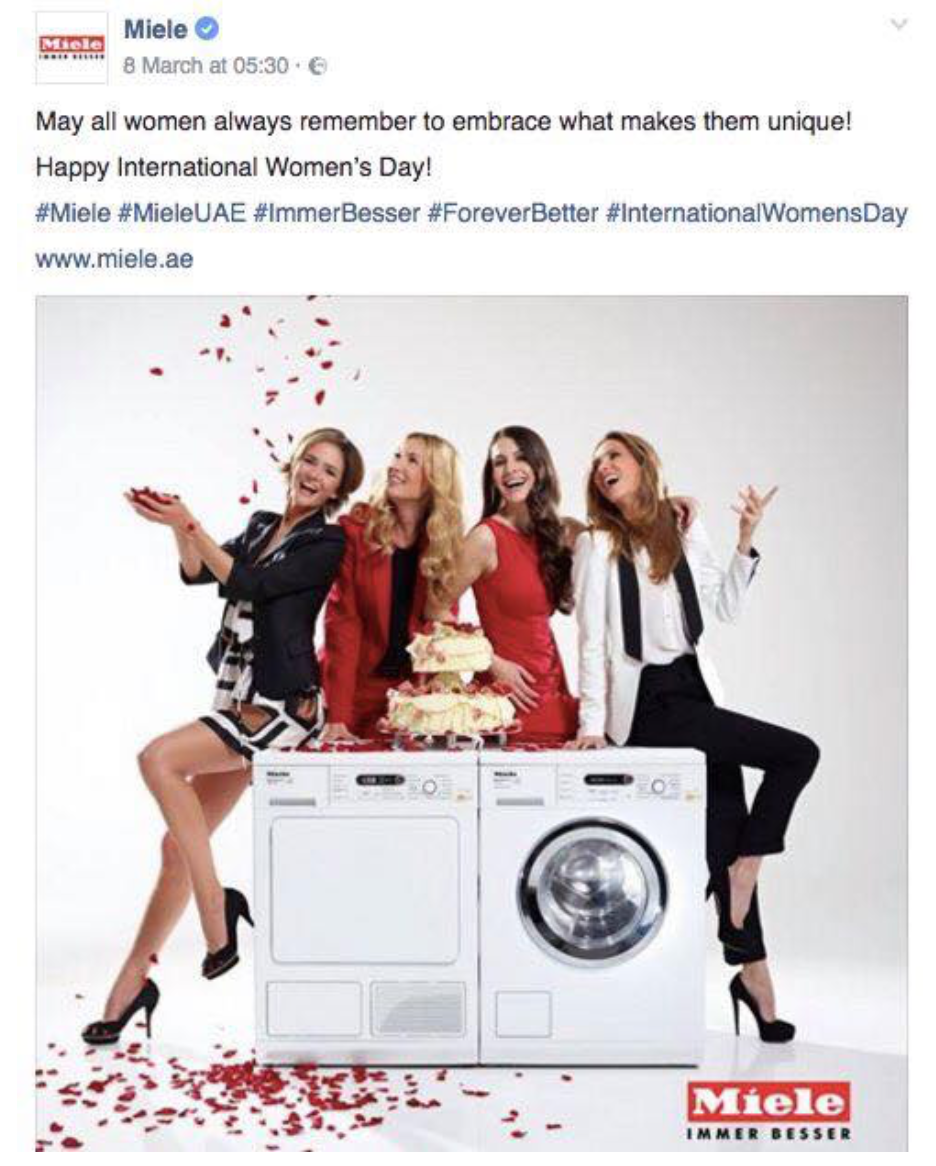
Sterotype picture about women from Miele ‘s offcial Twitter account
The failure
The German manufacturer of appliances Miele celebrated the International Women’s Day by posting on their social media accounts, including Instagram and Twitter. However, the picture they used in the post, which reinforced the stereotype that women should be responsible for housework, disrespected women and was inappropriate for celebrating the power and values of women. Although the post has been deleted after a few hours, it caused heated discussion (Contentworks Agency, 2019). This issue has been regarded as communication failure of Miele, and the problem lay in their failure of effectively managing their social media accounts . The following analysis will discuss the causes of their failure, what led to the failure, and how to avoid such a failure.
Why they fail
Some factors led to this particular failure of Miele’s post on the international women’s day. To begin with, Miele failed to convey appropriate messages on their social media platform while overly focusing on gaining profits. Understanding the audience is significant for expressing socially appropriate information and how this information will be understood by the audience, so the audience is essential for building the context (Boyd, 2010, p.10) In order to cater for the needs of the invisible audience, when participating online, people often imagine the feelings and understanding of their audience to decide whether or not their behaviors are socially appropriate and intrigue the audience (Boyd, 2010, p.10) In contrast, Miele failed to commit to their audience while managing their social media accounts, since most of their attention was diverted to connecting their product with the trend on that day. Furthermore, the effects of ‘collapsed contexts’ contributed to this failure as well. (Boyd, 2010, p.11) With the prevalence of online participation, people are forced to deal with audience from different and even conflicting contexts (Boyd, 2010, p.11). The target audience of Miele are those who share interest in appliances, and most of their are housewives or married ones. However, their potential audience could also be independent women who were successful in their careers. When Miele utilized the special day to promote their brand, they ignored their potential audience who would be offended after viewing the post instead of feeling respected as a woman. More importantly, social media provide technological tools for network publics not only to share interest and join the discussion, but also to stand together and combat the disrespect. (Boyd, 2010, p.1) In this case, persistence, replicability, scalability, and searchability accompanied the posting of offensive images on Miele’s twitter (Boyd, 2010, p.7) As a result, even though the inappropriate posts had been delated, the discussion about them did not stop, leading to negative effects on the company.
Another factor that may contribute to the failure of Miele’s post is related to the concept of ‘spreadable media’ (Fuchs, 2014, p3). The content is easier to broadcast because ‘technical affordance’ allows the social media platforms to connect their users together to exchange valuable information that drive users to create a shared media platform. (Green and Jenkins, 2011, p.112) The post of Miele’s included a heated topic that connected audiences through twitter to discuss the stereotypes facing women. Therefore, the post was widely retweeted and commented after it had been posted, which demonstrated that their audiences were using ‘technical affordance’ of social media to spread what Miele had posted and fight against it on twitter. (Green and Jenkins, 2011, p. 112) Although Miele chose to delete their tweet, the spreadablity of media allowed the spreading of the post to continue . Consequently, Miele ended up with criticism and negative comments that would undermine the brand’s reputation.
Additionally, the governance of twitter in ethic issues is not very strict and it lacks any clear ethic guidelines for users, which also contributed to Miele’s offensive post. According to Gillespi (2010,p.255), social media platforms such as Twitter should not only ensure legal activities of their users, but also emphasize personal and institutional ethics and be devoted to creating a healthy online community. In the case of Miele, the lack of supervision and restrictions on twitter resulted in the posting of inappropriate information. Although twitter is not responsible for the content posted by its users, it is still responsible for ensuring the users understand what is appropriate to post and what is not through clear guidelines (Gillespie, 2010,p.255). Miele’s social media failure resulted from the lack of awareness of suitable contexts. The lack of guidelines from twitter failed to enable Miele realize the issue in their tweet when they posted the stereotypical pictures, they were ignoring those independent women who were working hard to improve their social status. Accordingly, Miele’s post was criticized by the audience as it was presented in the image.
https://medium.com/@contentworks/social-media-fails-facebook-e7757c4e6946
Lastly, as a company for appliances, Miele’s main motivation for posting on the International Women’s Day was for commercial profits: through association with a trending topic on that day, their posts may allow more audiences to be involved with their advertisement. The ‘owned media’ enables companies to have more control over the use of their social media accounts, including managing their own Youtube channel and posting advertisement on their own (Serazio & Duffy, 2017, p.486). However, the company’s focus on profits without consideration for the audiences resulted in their social media failure. Thus, Miele was backlashed by women and men who supported women on their use of the stereotypical picture about women through their ‘commercial logic’. (Serazio & Duffy, 2017, p490). Ultimately, Miele’s unprofessional behaviour led to customer’s dissatisfaction and undermining of their brand.
How to avoid

The failure of Miele’s post could be avoided in two stages. The first stage is to predict the reaction and perspectives of audiences before publishing information on social media platforms. In this way, the company can ensure the post or image is appropriate to publish with the assistance of ‘content curation’ tools such as Flipboard and Pocket, therefore avoiding the risks on offending certain audiences (Graham,2019)Secondly, instead of simply removing the published post, Miele should also address the influence of its posts that might negatively affect its reputation. Taking ‘crisis management’ as an example of preventing the worst situtation happen to Miele.(Graham,2019)Personally, I would apologize to the offended pubics through tweets after deleting the inappropriate images, and continue to post more positive images about women to change the audience’s attitudes and express our sincerity. With these approaches, negative impact on Miele’s reputation will be greatly reduced. (Boyd, 2010, p.7)
Conclusion
In conclusion, the fail of Miele company resulted from an inappropriate post with disrespectful picture published on the International Women’s Day. The factors that had contributed to the post were social media failure, including the failure of predicting the potential audience’s reaction, and features of network publics, such as spreadability of social media, the lack of governance of social media platform and their business ambition . Lastly, Miele’s failure could be avoided if Miele had predicted their audience’s reaction and prevented the negative effects of the post on the company by equipping with crisis management ability.
Reference List
Boyd, D. (2011). Social Network Sites as Networked Publics – Affordances,
Dynamics, and Implications. A Networked Self – Identity, Community, and Culture on Social Network Sites, 39-58.
Contentworks Agency (2019, January 15). Social Media Fails-Facebook [Web log
post]. Retrieved from https://medium.com/@contentworks/social-media-fails-facebook-e7757c4e6946.
Fuchs, C. (2014). Social Media as Participatory Culture. In Social Media – a critical
introduction, 52-66.
Gillespie, T. (2018). Regulation of and by platforms. In J. Burgess, A. Marwick, and
T. Poell. The SAGE Handbook of Social Media, 254-278.
Green, J., & Jenkins, H. (2011). Spreadable Media. How Audiences Create Value and
Meaning in a Networked Economy. The Handbook of Media Audiences edited by Virginia Nightingale, 109-127.
Mcargobe (2018 October 13). FLIPBOARD: A PERFECT TOOL TO BOOST YOUR READING[Web log post].Retrieved from https://mcargobe.wordpress.com/2014/10/13/flipboard-a-perfect-tool-to-boost-your-reading-low-b2/
Serazio, M. & Duffy, B. (2018). Social media marketing.The SAGE Handbook of
Social Media, 481-496.
Timothy.G.(2019) KCB206 Social Media, Self and Society: Week 8[Lecture note]. Retrieved from https://blackboard.qut.edu.au/webapps/blackboard/content/listContent.jsp?course_id=_142802_1&content_id=_7846358_1


 Yazhe's blog
